Wednesday, May 26, 2010

Sig Jakucki

Now here is a fella I've wanted to do a card for for a long time. Sig was 6' - 2" of a whole lot of bad news. Hailing from the rough Polish tenements of Camden, N.J. he starred for his local Polish-American Citizens Club before escaping town to join the U.S. Marines in 1928. He quickly made a name for himself on the barracks baseball team in Hawaii and when he was released in 1931 he joined the semi-pro Honolulu Braves. Sig was such a popular player that when a scout suggested he could make the big leagues, the locals all chipped in to buy him a steamship ticket back to the mainland. He tried out for San Francisco of the Pacific Coast League and made the team. From the beginning of his professional career he was pegged as a constant brawler and big league boozer. He was traded from team to team because of his lousy personality and somehow made it all the way to the Browns in 1936 where he promptly had a falling out with manager Rogers Hornsby and was sent back down to the minors. Sig drank and fought his way out of the lowest level of ball and found himself a drifter in the southwest pitching on factory teams and town clubs in between hanging wall paper.

In 1941 he came into the spotlight when he pitched in the Denver Post Tournament which was a sort of world series of semi-pro teams. Representing the Bona Allen Shoe Company, Sig's team placed second. A few years later the majors were in dire need of ballplayers and someone dug up ol' Sig, still pitching away in the dusty southwest. Joining the St. Louis Browns again he was an instrumental part in their pennant winning season. But Jakucki's old habits never faded and fuelled with a major league-sized paycheck he found plenty of trouble. One of my favorite stories about him was when he was drinking at the bar of the New Yorker Hotel in Manhattan. Some greaseball low-level mafia punk was shooting off his mouth trying to impress some woman on the next stool. One thing led to another and the hood pulls his pistol on Jakucki who proceeds to snatch the piece from the tough-guy and beat him into hamburger meat right in the bar. Sig sits back down and finishes his drink before taking off to find a quieter place to finish the evening.

Another time he's at a wrestling match with teammate Euel Moore and seeing as the match was on the boring side, the two ballplayers invade the ring and start going at it themselves. The referee tries to break it up and Sig knocks him out cold and as the crowd goes nuts the two original wrestlers try to take on the big Polack whereupon they too are totally flattened by Jakucki. All hell breaks loose and when the dust clears Moore and Jakucki spent the night in the local jail.

Sig was tapped to pitch the pennant-clinching game and his teammates begged him to lay off the sauce for the night before the game. Pledging his total sobriety not to drink that evening, none-the-less players were detailed outside his room to make sure he didn't sneak out but sure enough ol' Sig kept his word to the letter. But no one said anything about the morning of the game and Jakucki had a few belts to keep himself strait and pitched a masterful game against the Yankees giving the lowly Browns their only pennant. Jakucki followed up his triumphant 1944 season with a disappointing '45. He just couldn't manage his drinking and everyday responsibility of playing on a big league team and he was released unconditionally when he turned up at the train station for a road trip with just a bag of scotch bottles. Sig wound up back in the southwest where he led a marginal transient existence dying in 1979 after years of poor health.

One-armed outfielder Pete Gray was on the Browns in 1945 and it is an interaction with Jakucki that I'll let be the last word on Sig. Although he could do almost anything despite his having one arm, Gray needed a teammate to tie his shoes for him before every game. One day no one is left in the locker room but Jakucki and Pete asks him to give him a hand. Jakucki glares at him and says "tie your own shoe, you one-armed son-of-a-bitch!"


Wednesday, May 19, 2010

29. Eddie Cicotte

This card is the first in a series I will be doing on the Eight Men Out, the players who were banned from organized baseball after being accused of throwing the 1919 World Series. I originally had the idea of depicting the players while on the 1919 Sox, complete with their season stats and series record. In fact I actually posted the Lefty Williams and Buck Weaver cards in this format. The more I thought about it though, I decided that I wanted to focus more on an aspect that always intrigued me, what did those players do AFTER they were banned. I had heard stories back where I grew up in Northern New Jersey of Shoeless Joe Jackson playing under fake names for little Jersey town teams back in the '20's, but found no proof. At the end of Eliot Asinof's great book "Eight Men Out" he leaves us with tantalizing mention of a Black Sox barnstorming tour. Was this team real? What did these guys do after the ban? Could they have just gave up playing the game they must have loved? Through my research and with the help of many historians who generously shared their material I will attempt to create an 8 card set of these guys and the outlaw teams they played on after Judge Landis threw them out of organised baseball in the Fall of 1920.

After being banned from organized baseball, the eight Chicago players implicated in fixing the 1919 World Series spent the 1921 season playing pick-up games in and around the Chicago area waiting in vain for an appeal of Commissioner Landis' decision. The players were not actually convicted of any wrong doing in any court and the office of Commissioner of Baseball was a new institution at the time. Like many people they underestimated the absolute power the commissioner now had. By the spring of 1922 they now understood the dire situation they were in and were not likely to be let back in the major leagues for the foreseeable future. Faced with the need to make a living the players decided to capitalize on their infamous notoriety. Eddie Cicotte joined Lefty Williams, Swede Risberg, Joe Jackson, Hap Felsch and Buck Weaver to form a barnstorming team called the “Ex-Major League Stars”. Lord knows how this name must have angered the new Commissioner of Baseball. The team played a few games around the mid-west but many fans ridiculed the dirty players and most teams refused to play the them due to warnings about doing so by Commissioner Landis. Young players did not want to be tainted by the association with the banned players and to do so could have a negative effect on their eligibility to move up to organised ball. Older players understood what a terrible mark the whole affair of 1919 cast over their beloved game and local newspapers who were usually more than enthusiastic about a barnstorming team of major league players coming to town now railed against the shunned players. All was not well in the Ex-Major League Stars camp, however and the team apparently broke up when Cicotte got into a fight with The Swede over money. The rough and tumble Risberg got the best of the match and reportedly knocked two of Eddie’s teeth out. This was the last time that many of the players were together on a team. Cicotte eventually drifted back to his farm and family in Michigan where he anonymously worked on the assembly line for Ford Motor Company.

Special thanks to the people over at the great site "The Shoeless Joe Jackson Virtual Hall of Fame Web Site" http://www.blackbetsy.com/ They were very helpful answering questions and sending me newspaper articles regarding the Black Sox after 1920.


Tuesday, May 11, 2010

28. Willard Brown

Back in 1947 as Jackie Robinson was breaking the color line in the National League, Willard Brown and Hank Thompson, two heavy weight negro league sluggers joined the American Leagues' St. Louis Browns. While Robinson was given a year of minor league seasoning to get acclimated to white organized ball, Brown and Thompson were sent directly to the big club. This move by the Browns ultimately hurt both the players and the team as they were not able to adapt to the huge cultural difference and senseless racism they encountered. They were unable to sleep in the same hotel as their teammates who were pretty much indifferent to their presence on the club. On August 13, 1947 Brown belted a Hal Newhouser pitch into the far reaches of Sportsmans Park and quickly rounded the bases for an inside the park home run, the first by a black player in the American League. Instead of celebrating the feat, teammate Jeff Heath, whose bat Brown used, broke it in half rather than have him use it again. After 21 games and a low batting average both Brown and Thompson were released. Thompson had a second chance with the Giants a few years later and made good but Willard Brown never made it back to the majors, spending the next 10 years in the negro and minor leagues where he continued his legendary status as one of the games best sluggers.

As the mighty Kansas City Monarchs' batboy, Willard Brown dreamed of playing for the Monarchs. In 1935 he realised that dream when he became the team's starting shortstop. Soon moved to the outfield to take advantage of his speed, Brown became black baseball's most prolific hitter. He hit for a high average and was also one of the fastest ballplayers of the late 1930’s. Brown was sometimes accused of being lazy in the field, saving his strength for larger crowds and more important games but at the same time he was considered to be a superior outfielder and was voted to the All-Star Game 8 times. He hit well above .300 for his whole negro league career and led the league in doubles, triple, home runs and stolen bases many times. The Monarchs of the late '30's and '40's were a powerhouse and Brown was instrumental in their winning the pennant 5 times during his time with the team. During the war Brown played on the champion ballclub that won the European Theater World Series and he hit the winning home run of the deciding game giving Leon Day the victory over Ewell Blackwell and Patton's 4th Army team made up of major league players. He then played ball in the negro and minor leagues until 1957. Popular with players and fans, Brown was elected to the Hall of Fame in 2006.

Monday, May 3, 2010

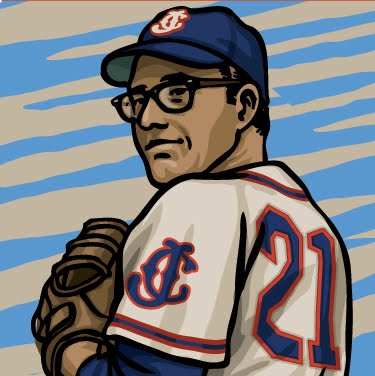
27. Sandy Koufax

I am sorry but I was instructed to take down the Sandy Koufax card because it is in violation of college licensing laws. It was a nice looking card and I thought it did credit to and brought attention to the fact that the great Sandy Koufax went to the University of Cincinnati.

When Sandy Koufax, arguably the greatest left-handed pitcher ever, enrolled at the University of Cincinnati in 1953 it was not to play college baseball for the Bearcats, but to become an architect. At a time when becoming a major league baseball player was the most glamorous thing most kids could wish to be, the career of an architect was Koufax's dream and the University of Cincinnati was the place to start. Then as now, U.C. is one of the world's finest architecture schools and just being admitted to the program is an achievement. A natural basketball player, he made the school’s varsity team as a surprise walk-on freshman. You see, Koufax was a well-known basketball player back in Brooklyn and played baseball in the summer basically to keep in-shape until basketball started up again. After a successful season on the college boards, Koufax further impressed coach Ed Junker by showing that he could pitch as well and he made the varsity Bearcat baseball squad in the spring of 1954. He had a blazing fastball but was very wild. The regular catcher refused to catch him and legend has it the coach would have Sandy warm up on the sideline and let the opposing team see his screaming 100 mile per hour fastball of which he had no control over. It was intimidating to say the least. He averaged about 1 walk per inning his first and only year in college competition. On the other hand, he had almost 2 strike-outs per inning and by the end of the college season the Brooklyn Dodgers had signed Sandy Koufax to a lucrative contract. Back when he was in high school, the Dodgers had apparently scouted him but the report was misfiled. At the time he could have been signed for a bargain price but now other teams began to take notice. He negotiated a bonus large enough to cover the rest of his architecture school tuition if baseball did not pan out. Due to the large amount of the bonus, major league baseball rules at the time dictated that he be sent directly to the majors and not farmed out to a minor league team for seasoning. To make room for the young fireballer, the Dodgers looked over their roster and sent their least effective pitcher down to the minors. That pitchers name was Tommy Lasorda.

I'd like to thank my good friend Christian Boyles, Aquisitions Librarian at Xavier University and University of Cincinnati Alumni for his tireless research to get an example of the jersey worn by the 1954 Bearcats. I try to get the uniforms worn by the players in my cards as historically accurate as possible and this was a tough one to nail down. But somehow, Boyles came through!